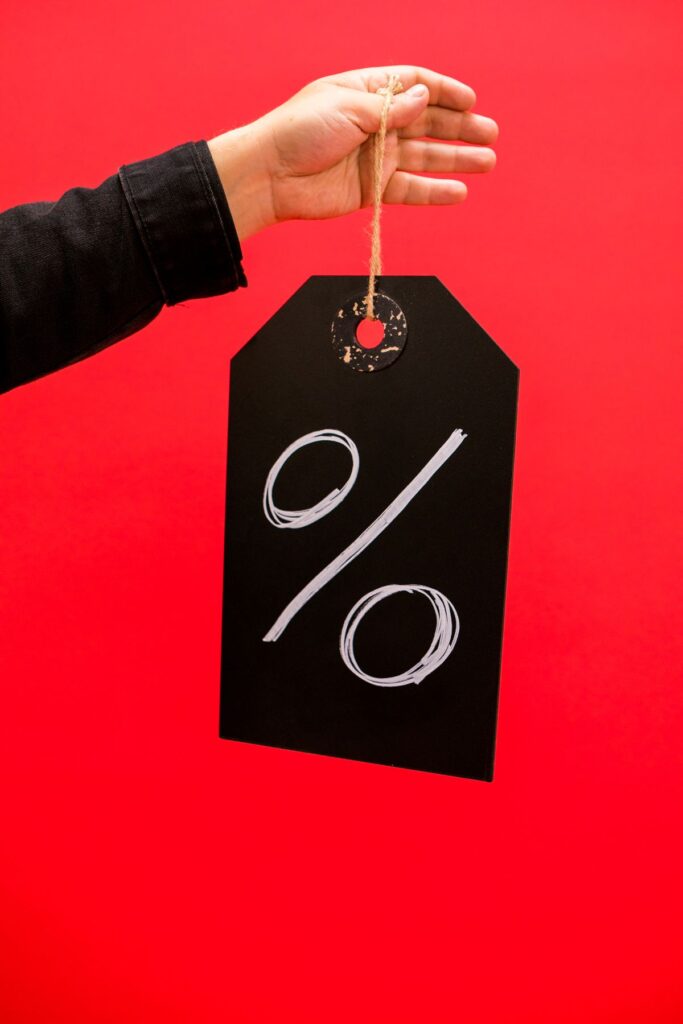
A bright red tag says “70% OFF.” The original price is crossed out, the sale price looks like a bargain, and a countdown timer warns that the offer ends tonight. It feels like a deal you would be foolish to miss. But is it?
Too often, the answer is no. Retailers have become skilled at making ordinary prices look like extraordinary savings. They inflate the “was” price, raise prices just before a sale so the discount looks bigger, create special low-quality models for sale events, and use urgency tactics that push shoppers into buying before they have time to check. The result is that millions of people pay full price — or more — while believing they got a bargain.
This guide teaches you how to tell a real discount from a fake one. It explains the tricks retailers use, the checks you can run in under a minute, and the habits that will protect you every time you shop. No specific prices or discounts are quoted here as live offers — any figure used as an example should be treated as [TBD — verify before publishing].
What Is a Fake Discount?
A fake discount is any promotion that makes a price look like a saving when it is not. The most common form is an inflated reference price: the retailer claims a product “was” a certain amount, but the product was never actually sold at that amount, or was only sold at that amount for a very short time. The discount percentage is calculated from the inflated figure, so it looks large even though the sale price is ordinary.
Another form is the pre-sale price rise. A retailer raises the price of a product a week or two before a sale event, then “discounts” it back to its normal price — or slightly above it — and advertises a large percentage off. The shopper sees a big discount; the retailer sees a normal sale at a normal price.
A third form is the special sale model. Some products sold at very low prices during big events are variants made specifically for the event, with cheaper components or fewer features than the regular model. The price is real, but the comparison is misleading, because the shopper believes they are buying the regular model at a discount.
None of these tactics is always illegal, and the rules vary by country. In many places, consumer protection law requires that a “was” price reflect a price the product was actually sold at for a meaningful period. But enforcement is uneven, and the burden of checking usually falls on the shopper. That is why the skills in this guide matter.
Trick 1: The Inflated “Was” Price
This is the most common trick, and the easiest to understand. A pair of headphones is advertised as “was $200, now $100 — 50% off.” But if you check the price history, you find the headphones were selling for $120 for most of the past six months, and only briefly touched $200 when they first launched. The real saving is $20, not $100.
How to check: use a price history tool. Many browser extensions and shopping websites show the price of a product over time. Before you buy, look at the price over the past three to six months. If the “was” price was only charged for a few days, or months ago, the discount is exaggerated. If the sale price matches the price from a month ago, there is no discount at all.
A useful rule of thumb: a discount is only real if the sale price is lower than the price the product sold at for most of the recent past. The “was” price on the tag is a claim, not a fact. Treat it as unproven until you have checked it.
Trick 2: The Pre-Sale Price Rise
This trick is harder to spot without a price history, which is exactly why retailers use it. The pattern works like this: a retailer raises the price of a popular product in the weeks before a big sale, then cuts it back during the sale and advertises a large discount. The sale price may even be higher than the price before the rise.
Example: a television sells for $800 for months. Two weeks before a major sale event, the retailer raises it to $1,000. During the event, it is advertised as “was $1,000, now $800 — 20% off.” The shopper pays the same $800 they could have paid a month earlier, but feels they saved $200.
How to check: the same price history check catches this trick. Look at the price two or three months before the sale, not just the week before it. If the price jumped shortly before the sale, the discount is an illusion.
This is also why it pays to track prices year-round, not just during sales. If you know what a product normally costs, a sudden pre-sale rise is obvious.
Trick 3: The Special Sale Model
Some products that appear in big sales are not the same products you see at other times of year. They may share a brand and a similar name, but they have a different model number, and that model number tells the story. Sale-only variants often have a cheaper display panel, less memory, a slower processor, or fewer features than the regular model.
This is most common with televisions and laptops sold during the biggest sale events. A television advertised at a very low price may be a model that is only sold during that event, with a panel and features that reviewers have never tested. A laptop at a startlingly low price may have half the storage or memory of the model you thought you were buying.
How to check: always compare model numbers, not just brand names. Search for the exact model number on the manufacturer’s website and in reviews. If you cannot find the model reviewed anywhere, or if the manufacturer’s site does not list it, be cautious. If the specifications are worse than the regular model in the same range, the low price may not be a bargain at all.
A related trick is the bundle that is not a bundle. A retailer may advertise a “bundle” of a laptop, a bag, and a mouse at a combined discount, when the individual items were never sold at the prices claimed. Check the price of each item separately before deciding the bundle is a deal.
Trick 4: Urgency and Scarcity Tactics
“Only 2 left in stock.” “Sale ends in 3 hours.” “1,247 people are viewing this item right now.” These messages are designed to make you buy before you think. Some of them are genuine — stock really does run out, and sales really do end. But many are generated automatically, or are simply untrue, and their purpose is to short-circuit your judgement.
The most effective defence against urgency tactics is a simple rule: never buy a product you have not researched, no matter how urgent the offer seems. If a deal is real, it will usually still be there after you have spent five minutes checking the price history. If it disappears in five minutes, it was probably not a deal worth having — or it will return in the next sale.
Countdown timers deserve particular scepticism. Many online stores run timers that reset when they expire, or that count down to a deadline that is then extended. If you see a timer, note the deadline, close the page, and come back after it expires. If the same “expiring” offer is still there, you have learned something important about that retailer.
Stock warnings are similar. “Only 2 left” may be true for a specific warehouse, or it may be a standard message shown to every visitor. Either way, it is not a reason to skip your checks. A product that is genuinely scarce will still be scarce after a five-minute price check.
Trick 5: The Misleading Percentage
A “70% off” label is powerful, but percentages hide the actual saving. Seventy per cent off a product that was overpriced by 70 per cent is no saving at all. And a large percentage off a cheap item may be worth less than a small percentage off an expensive one.
Always convert percentages into actual money. If a product is advertised as 50 per cent off, work out what that means in your currency: what was the price, what is the price now, and how much are you actually saving? Then ask whether that saving is real by checking the price history.
Another version of this trick is the “up to” discount. A retailer advertises “up to 70% off” across a whole category, but only a handful of items are discounted by 70 per cent, and most are discounted by 10 per cent or not at all. The headline number draws you in; the reality is in the fine print. When you see “up to,” assume the discount on the item you actually want is much smaller, and check it individually.
Trick 6: The Free Gift and the Extended Warranty
“Buy now and get a free gift worth $50.” “Add an extended warranty for only $30.” These offers are often presented as savings, but they deserve the same scrutiny as a discount.
A free gift is only valuable if it is something you actually want and would otherwise buy. A free case for a phone you are buying anyway is useful. A free accessory you will never use is worth nothing, no matter what the retailer says it is worth. And the claimed value of the gift is often inflated in the same way as an inflated “was” price.
Extended warranties are a different kind of trap. They are often highly profitable for the retailer, which is why they are pushed so hard. Before buying one, check what your existing warranty already covers, what your consumer rights already provide, and what the extended warranty actually adds. In many cases, the manufacturer’s warranty and your statutory rights already cover the most likely problems.
The Five-Minute Verification Checklist
Before you buy anything advertised as a deal, run through this checklist. It takes about five minutes, and it will catch most fake discounts.
- Check the price history. Use a price tracking tool to see what the product cost over the past three to six months. Is the sale price genuinely lower than the usual price? Was the “was” price actually charged for a meaningful period?
- Compare the price at other retailers. Search for the same model at two or three other stores. If every retailer is selling it for the same “sale” price, the discount may be a manufacturer promotion — which is fine — or it may be that the “was” price was inflated everywhere. If one retailer is much cheaper, find out why.
- Check the exact model number. Make sure you are comparing the same product. A single letter difference in a model number can mean a different screen, a different processor, or a different amount of memory.
- Read the fine print. Check whether the discount applies to the product you want, or only to selected items. Check the return policy, the warranty, and whether delivery is included. A low price with a no-returns policy is a different proposition from the same price with a full return window.
- Ask yourself if you need it. The most effective fake discount is the one that persuades you to buy something you did not need. If you were not planning to buy the product before you saw the sale, the “saving” is not a saving — it is spending you would not otherwise have done.
Tools That Help You Check Prices
You do not need to do this work from memory. Several free tools make price checking quick and routine.
Price history extensions. Browser extensions exist that show a price history graph directly on a product page. Install one for the retailers you use most, and checking a price becomes a glance rather than a research project.
Price tracking websites. Some websites track prices across many retailers and let you set alerts. Enter the product you want, set your target price, and you will be notified when it reaches that level.
Shopping comparison sites. These let you compare the same product across retailers in one view. They are useful for spotting a retailer that is charging more than everyone else, and for finding the genuine lowest price.
Manufacturer websites. The manufacturer’s own store often lists the recommended price, which gives you a baseline. If a retailer’s “was” price is far above the manufacturer’s price, that is a red flag.
Review sites. Professional reviews usually mention the launch price and the price at the time of review. If a review from six months ago quotes a price far below the retailer’s “was” price, the “was” price is suspect.
None of these tools is perfect, and price histories can have gaps, particularly for products sold by smaller retailers. But used together, they give you a reliable picture in minutes.
How to Read a Sale Price Like a Professional
Experienced deal hunters use a simple framework. Before they buy, they answer four questions.
What is the product’s normal price? This is the price it has sold at for most of the past few months, not the highest price it ever reached. If you do not know the normal price, you cannot judge a discount.
What is the lowest price it has ever reached? This tells you what is possible. If the current sale price is close to the historical low, it is a good deal. If it is far above the historical low, you may want to wait.
Is this the product I actually want? Check the model number, the specifications, and the reviews. A cheap price on the wrong product is not a deal.
Would I buy this at this price if there were no sale? This is the most important question. If the answer is yes, and the price is genuinely low, buy it. If the answer is no, the sale is persuading you to spend money you did not plan to spend, and the “saving” is an illusion.
Write these four questions on a card and keep it near your computer during sale season. They take thirty seconds to answer, and they will save you from most bad purchases.
What to Do When You Find a Fake Discount
If you discover that a discount is misleading, you have options. First, do not buy the product at that retailer — at least not at that price. Check other retailers, and check whether the manufacturer’s own store offers a better price.
Second, consider reporting it. Many countries have consumer protection agencies that investigate misleading pricing, and retailers do change their behaviour when complaints are filed. Keep a screenshot of the advertised price and the price history as evidence.
Third, tell other people. A short post or review warning others about a misleading promotion can save many shoppers from the same trap, and retailers pay attention to public criticism.
Finally, do not blame yourself. These tactics are designed by professionals to be hard to spot, and they work on experienced shoppers too. The fact that you caught one means your checks are working.
Real Discounts Do Exist — Here Is What They Look Like
This guide is not meant to make you cynical about every sale. Genuine discounts are common, and they follow recognisable patterns. A real discount usually has these characteristics:
- The sale price is lower than the price the product sold at for most of the past few months, not just lower than a brief peak.
- The discount appears at a predictable time — a seasonal sale, a clearance before a new model, or a major shopping event — rather than at a random moment.
- The same product is discounted by a similar amount at several retailers, suggesting a genuine manufacturer or market-wide promotion.
- The model number matches the regular product, with the same specifications you would expect.
- The retailer is transparent about the terms: the sale price, the return policy, and the warranty are all clear.
When you see all of these together, you have probably found a real deal. Buy with confidence — and enjoy the saving.
Building a Habit That Protects You Year-Round
The checks in this guide are most valuable when they become habits rather than occasional efforts. Here is a simple system.
Keep a wish list with target prices. For every product you plan to buy, note the product name, the model number, the normal price, and the price at which you will buy. Update it monthly. When a sale arrives, you will know immediately whether the price is genuinely good.
Set price alerts. Use a tracking tool to alert you when a product reaches your target price. This removes the need to check constantly and ensures you never miss a genuine drop.
Wait 24 hours for unplanned purchases. If you see a deal on a product you were not planning to buy, wait a day before purchasing. Most impulse purchases do not survive a night’s sleep, and the deal will usually still be there tomorrow. If it is not, it was probably not a deal you needed.
Review your purchases quarterly. Every few months, look back at what you bought on sale and check whether the price dropped further afterwards, or whether you actually used the product. This review sharpens your judgement and reveals which retailers and sale events genuinely save you money.
Frequently Asked Questions
Is it illegal for a retailer to inflate a “was” price? The rules vary by country, but in many places consumer protection law requires that a reference price reflect a price the product was actually sold at for a meaningful period. If you believe a retailer is breaking the law, you can report it to your local consumer protection agency. This article is general information, not legal advice.
How long should a product have been sold at the “was” price for the discount to be real? There is no universal rule, but a useful standard is that the product should have been sold at that price for a meaningful period — often several weeks — in the recent past, not just for a few days at launch. Check the price history and use your judgement.
Are “up to 70% off” sales always misleading? Not always, but the headline number rarely applies to the products most people want. Always check the discount on the specific item you are interested in, rather than assuming the headline applies to it.
Can I trust price history tools? They are generally reliable for major retailers, but they can have gaps, particularly for smaller stores or products that change model numbers frequently. Use them as a guide, and cross-check with a second source when the saving is large.
What is the single best check for a fake discount? Check the price history. It takes a minute, and it catches the two most common tricks — the inflated “was” price and the pre-sale price rise — in one step.
Should I still buy a product if the discount is fake but the price is fair? Yes, if the price is fair and the product is one you need. The problem with a fake discount is not the price itself — it is the misleading claim. If the price is good on its own merits, buy it. But do not let a fake discount persuade you to buy something you do not need.
The Bottom Line
A real discount is a price that is genuinely lower than what a product usually costs. A fake discount is a price that only looks lower because the comparison is rigged. The difference between them is almost always visible in the price history, the model number, and the fine print — and checking those three things takes about five minutes.
Make those five minutes a habit, and you will stop paying full price while believing you got a bargain. You will buy less, but you will buy better, and the money you save will be real.
Any prices or discounts used as examples in this article are illustrative only, not live offers. Always verify the current price before buying — any specific figure should be treated as [TBD — verify before publishing].